Wednesday, July 4, 2012

Pragmatic Idealism

The following is an essay I submitted for a contest.  Like this on Facebook at this link and I can win monies!

https://www.facebook.com/jerry.hale.54/posts/337845472959173?notif_t=like


As Americans, we pledge allegiance to the flag as a symbol of our loyalty to “liberty and justice for all.”  As citizens of Utah, we share values that make us very sensitive to government over-reach that treads on our liberty.  We often neglect, however, to recognize government’s role to ensure that justice for all goes hand-in-hand with liberty.  We often let our ideals cloud our judgment and impede pragmatic solutions.  

The moment a person, business, or organization takes actions that restrict the freedom to pursue happiness or obstruct the use of our property, the government is charged to take action.  As goes the saying attributed to Oliver Wendell Holmes, “Your right to swing your arms ends just where the other man’s nose begins.”  This analogy can be extended even further to say that if the man’s nose were broken, it would affect not only his liberty and happiness, but that of those in his sphere of influence.  At some point in this analogy, liberty must be limited to resolve the conflict.  Public policy and governance deals with exactly that concept—deciding how much of whose liberty must be sacrificed in order to ensure the greatest liberty and justice for the population as a whole.

One example that is still fresh on our minds is health care.  Many conservatives and libertarians in Utah were up in arms when the Supreme Court ruled that we could be compelled to purchase insurance or face a tax.  And rightfully so, for many reasons.  But the predominant voice was in opposition to socialized health care and a government takeover.  The debate was full of patriotic defense of the Constitution, but it lacked a sincere discussion to seek solutions to the problems of our health care system.  

Gone are the days that we can sit on our porch with a shotgun to protect our family and property.  Gone are the days when individualism and hard work alone gives us the best chance for prosperity and security.  We are now too interdependent to ignore the plight of our neighbor—for even a truly self-interested person must recognize that no man is an island.  If your neighbor is diagnosed with a treatable cancer and their insurance denies them coverage, you may feel it is as sad story, but that it would be unjust to have the government force you to pay for their treatments.  But if untreated, the cancer patient will eventually end up in the emergency room and cost you thousands of dollars anyway, either through taxes or higher medical payments.  And now your neighbor is dead and his wife and children become a greater financial burden on society.  

Wouldn’t it be better if instead of arguing over whose political views were more constitutional, we discussed how we could implement specific and practical policies?  Using quotes from our Founding Fathers to argue ideology may be fun, but why don’t we do what the Founding Fathers actually did and sit down and deal with the conflict through compromise.  Find a common-ground solution and then go out and take action and make it work.

Even John Locke, the father of classical liberalism, felt that the sole right to defend our liberty in the “state of nature” was not enough.  In Utah we have an abundance of land and ample opportunity to build individual prosperity with less interference from government than many more urban parts of the country.  But with advancing technology, increasing population, and changing demographics we are going to be forced to find new solutions to these new problems.

This is not an endorsement of bigger government, but of smarter government.  This is not to say that we simply need to elect better officials so that our government can take better care of us.  It is to say that we need a stronger government for the people—by the people.  

As Robert Putnam put it, we need more “social capital.”  We need to be engaged in the solutions, not just the debates.  Governments derive their just powers from the consent of the governed.  If we think that government is going too far, it means that we as a people are not going far enough.  Pragmatic Idealism does not mean being untrue to your strongly held ideals.  It means recognizing that just as the United States would have never had been a successful experiment without compromise, so too will we be unsuccessful in achieving liberty and justice for all if we are more loyal to our philosophies than we are to finding practical solutions.

Friday, June 8, 2012

In a sense


(a few thoughts and questions after contemplating Kyle's blog post)


What instruments are we born with to obtain knowledge?  What physiological capacities do we have at our disposal to observe and interpret data?  Sight. Sound. Smell. Touch. Taste.  Is that it?  Or is it possible there are other senses that we are not so easily attuned to because they are not necessary for individual physical survival or the perpetuation of our species?

If a man is born blind, he will rely more on his sense of hearing to determine truth.  If a man is born deaf, he will likewise see things we never see.  Or more correctly, he will observe and interpret things that our eyes see yet our minds ignore and fail to process.  So is it possible that if we hear but don’t understand and we see but do not perceive that there may be other senses that we can feel but do not learn from? 

 Is the truth learned from any single one of these five senses any more true than another?  Does seeing the sun give you truth that is any truer than feeling its heat on your skin?  Or the stars—they are too far away to observe through touch.  They must be learned only through one sense, sight.  Perhaps there are other truths in the universe that can only be learned through one sense.  If that is a spiritual sense, would it not be important to attune that sense to attain increased knowledge? 

Furthermore, is it possible that even a finely attuned sense can lose its potency if not maintained?  If muscles atrophy without use, it is not because the potential power of the muscles doesn’t exist.  The spiritual sense it requires faith, but faith is not enough.  It takes a lot of work.  One could be defiant toward the power of the sense of sight by closing his eyes, but to be defiant toward the spiritual sense only requires apathy.

Friday, September 30, 2011

The Best Thing Since Sliced Bread, Baby

Sept. 15, 2011

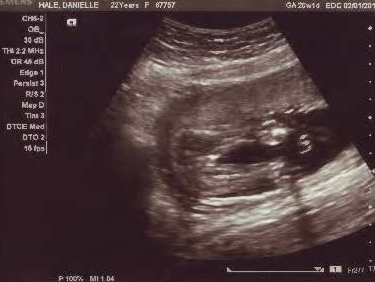
Danielle reached 20 weeks and we finally got to find out what gender our first child would be. We walked into the ultrasound room with the spunky technician lady, not really knowing what to expect. Danielle really wanted a girl so that she could dress it up and put ribbons and bows on it. I wanted a boy that I could indoctrinate with BYU sports. But in the end, neither of us had a strong preference.

Turns out, this technician lady really had a way with words. She was very effective in helping you visualize things in a way you never would have considered.

First she showed us an overall picture of the baby moving around, which was really cool:


Then we listened to the heartbeat again and she measured to make sure it was at a normal rate:


Then the technician started examining all the vitals and organs and limbs. To make sure we understood what she was looking at, should would give us some graphic metaphors, starting with the head:


"Now you see the top of the head with the little hand against the face. Now, imagine that the baby is a loaf of warm bread. We are going to go down and slice one chunk at a time and take a look at what we have inside! Oh, look—there, you can see the brain matter! It's like jelly on your slice of bread!"

And thus she continued on each level as we sliced through our unborn child. To be fair, it was very interesting and really neat to see everything displayed up on the video screen, but the analogies were a little odd.

Then she checked to make sure the baby had all its limbs:


There are the legs.


There's one little foot. The technician lady was really obsessed about the feet. She kept trying to convince us that the feet are the cutest part of the baby.

Then she tried and tried to get a good view to find out the gender, but of course the baby had its legs tucked behind and closed so we couldn't see anything. The lady gave a few nudges and the baby stretched out its legs but still kept them closed.

So Danielle went for a little walk around the block, did a few jumping jacks, and a back-flip, and then we went back inside for another try. Finally we got a good view. The technician said, "Now imagine your baby is naked and sitting up on a glass table and you are laying down underneath the table looking up. What do you see between those legs?"


To which Danielle answered, "Nothing!"


Sure enough, it's a baby girl!

We are both very excited and Danielle assured me that we would get our little girl something like this, so I can still indoctrinate her:


The down side is, we had a boy name basically decided upon, but we have no idea which girl name we like best. We won't tell anyone the name until the baby is born, but feel free to send us suggestions!

Wednesday, August 18, 2010

All the Rusted Signs We Ignore Throughout Our Lives


I grew up on a street with a sign that read "SLOW CHILDREN AT PLAY." I'm still not sure if that was a comment on our intelligence or our athletic ability.

I also frequently see signs that say "DEAF CHILD AREA." I'm never quite sure what I'm supposed to do when I see this sign. Do I slow down? Or is it just supposed to make me feel bad that I have a perfectly good pair of ears? I don't see a reason I should have to go any slower than in any other residential area. I mean, it's not like they can't see me coming. They just can't hear me if I honk at them. I wonder what I would do if there was a deaf child in the middle of the road... I don't know the hand signal for "honking noise."

"SLIPPERY WHEN WET" is just a little too patronizing to even take serious. Sounds like something that should be in a children's book. A slow, deaf children's book. It's also not a very useful sign because it doesn't tell us if it's even wet now. How are we supposed to know if we should even worry about the slipperiness unless we know whether or not it's wet? That's like putting up a sign in Kansas that says "TORNADOES ARE DANGEROUS" and assuming that will keep everyone safe.

Speaking of slow children, the other day I was riding in the car with an unnamed relative who was driving quickly through some curving roads when we approached several people crossing ahead. They were carrying boxes and bags and heading across the street to a grassy park. They didn't seem to care about hurrying even as we quickly sped toward them. In fact, a couple of them stopped in the middle of the road and one turned back to join another who was lagging behind the group. My unnamed relative was frustrated as he put on his breaks and said, "What a bunch of ret—" and then was close enough to see that they all had Down Syndrome.

Wednesday, August 11, 2010

That Was One Dank Burrito!

I've always been a big fan of eating a balanced diet. I've always made sure to balance out any healthy foods I eat with a healthy portion of meats and sweets. My wife often complains that I eat too many carbs. Her rational for proper food consumption is often difficult to understand.

Like one time when I offered her a treat that I was eating, she declined, making a disgusted face. I said, “Don’t you like it?” She responded, “Yeah, it’s just a waste of calories. I’ll save them for something I’ll enjoy more.”

Waste of calories? I didn’t know we had a limit?!?! I thought we can have the good sweets and the better sweets?!?! It’s like she’s confused calories with cell phone minutes and put herself on a 700 calorie per day plan—except no free nights or weekends. And I’m thinking, well I didn’t eat many sweets yesterday so I’ll just use my roll-over calories and eat her portion.

Speaking of sweets, someone at work today brought in a cake today which she called “Better-than-sex Cake.” What a weird comparison. I mean, the cake was delicious: chocolate with drizzled chocolate sauce and candy bar chunks crumbled on top. But to use such a title to describe how good the cake tastes seems to be a bit irrelevant. I mean, the other day I ate a nasty bean burrito that gave me terrible heartburn. But I didn’t call it "Worse-than-the-holocaust Burrito."

Thursday, July 8, 2010

Goat Bones

Here's a hilarious phone call I had at work today. I was calling for Lisa but her Indian personal assistant answered. The ending was partially cut off but just so you know, he starts crying and hangs up.

I don't say much because my phone is on mute while I laugh my head off.